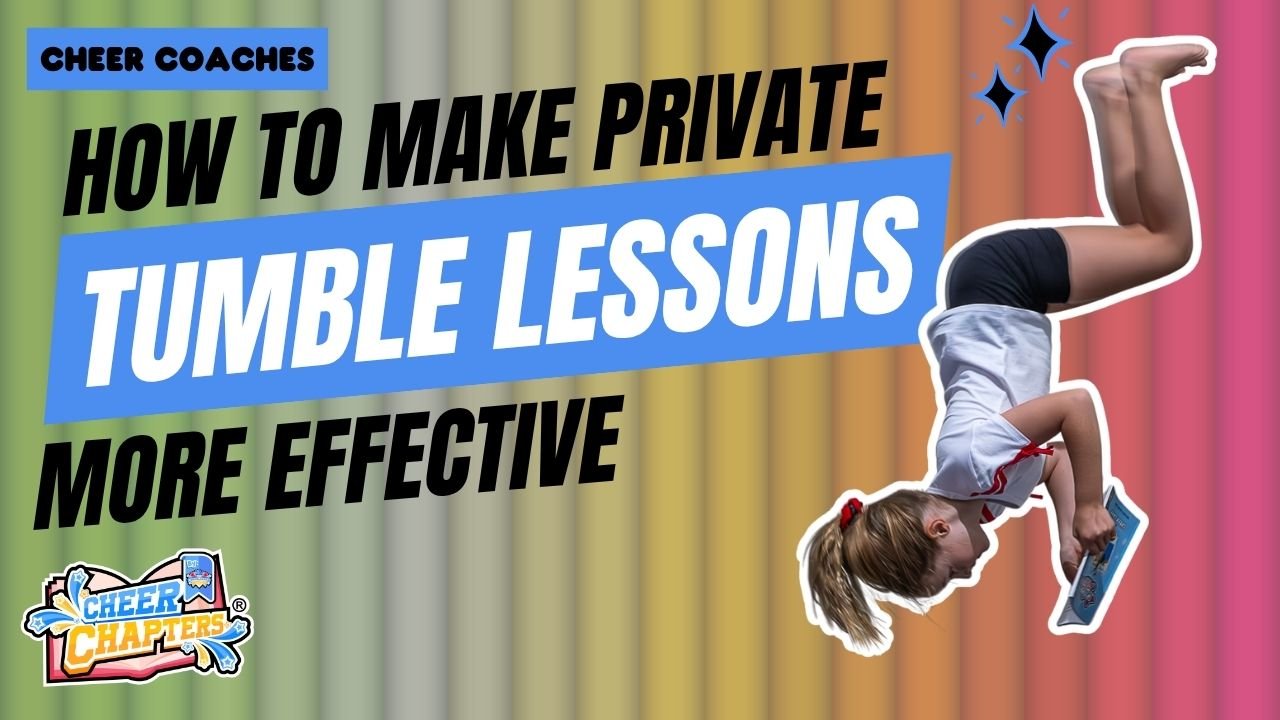
A private tumbling lesson shouldn’t only help an athlete for the hour you are standing beside them.
The real value comes from teaching them what they can safely work on between sessions—and making sure they understand how to do it correctly.
I don’t currently coach inside my own fully equipped all-star cheerleading gym. I hire different locations, including schools, churches and other suitable spaces.
When an athlete asks me for private tumbling lessons, my favourite option—when it is appropriate and practical—is to coach them using the safe space and equipment they already have at home.
That might sound more restrictive than working inside a gym filled with equipment, but it has one enormous advantage: the athlete can continue using the drills after I leave.
Use the Equipment the Athlete Actually Has
All-star gyms give coaches access to sprung floors, trampolines, wedges, blocks, bands and plenty of other useful equipment.
That’s fantastic during the lesson, but what happens when the athlete goes home?
If every drill depends on equipment they don’t have, they can’t practise the same progressions between sessions. They either do nothing until their next lesson or attempt to recreate the drill incorrectly with unsuitable equipment.
When I coach athletes at home, I can see exactly what they have available and design their drills around it.
If the athlete has an appropriate mat, air track or other suitable equipment, I can show them how to use it correctly. If they don’t have much equipment, I can focus on safe conditioning, flexibility, shapes and technique drills that are suitable for their environment.
The goal isn’t to force a full gym session into somebody’s garden. It’s to give the athlete useful work they can realistically repeat.
Safety and Child Protection Come First
Any private lesson involving a child needs clear safety and child-protection procedures.
A parent or responsible adult should be present throughout an at-home lesson. The coach should never be alone with the athlete inside the home.
The training area, surface and equipment also need to be checked before the lesson begins. Coaches must work within their qualifications, insurance requirements and applicable child-safety policies.
Most importantly, children should not practise new, unsupported or high-risk tumbling skills alone.
Any exercises completed between sessions should be drills the qualified coach has specifically assessed as suitable for that particular athlete, environment and equipment. Parents can encourage and supervise, but they should not attempt to spot a skill unless they are appropriately trained to do so.
Plan the Lesson Before Starting
Private lesson time disappears very quickly.
Before the session, I ask the athlete what skills they are currently working on and what they hope to achieve next. That allows me to decide where our time will be most useful.
Where appropriate, I also ask the athlete to complete their normal approved warm-up before I arrive, with their parent present. This means we don’t spend a large part of the paid private lesson going through familiar movements they already know how to complete safely.
At the beginning of the lesson, I still check that the athlete is physically and mentally ready to train.
From there, we can focus on:
- Their current tumbling skill
- The technique problem preventing progress
- Strength, flexibility or body-shape drills
- Safe progressions towards the next skill
- Exercises they can repeat between lessons
- A simple practice plan they can remember
A private lesson should be personalised. It isn’t just a smaller version of a general tumbling class.
Give Athletes a Visual Reference
One of the most effective things I do is record short videos of the drills during the lesson, with the parent’s permission.
I send the videos to the parent so the athlete can refer to them later.
Sometimes I record myself demonstrating the drill. At other times, I record the athlete, replay it in slow motion and show them exactly where their body is compared with where we want it to be.
That immediate visual feedback can be extremely powerful.
A child may hear “straighten your legs” or “push your shoulders” repeatedly without fully understanding what the coach can see. Watching their own movement helps connect the correction with what their body is actually doing.
The videos also prevent the athlete from trying to remember an entire lesson several days later.
Record the Small Things Too
Videos don’t need to show impressive tumbling skills to be helpful.
During one lesson, an athlete couldn’t remember the sequence of her regular split stretches. I recorded a sped-up video of us completing the sequence together.
She could then watch it at home whenever she needed a reminder.
You can record:
- Approved warm-up or stretching sequences
- Conditioning exercises
- Handstand shapes
- Body-position drills
- Safe flexibility exercises
- Equipment setup
- The number of recommended repetitions
- A short demonstration of the main correction
Keep each video simple and focused. One clear drill per clip is usually easier for a child to follow than a long recording of the entire lesson.
From a Kickover to a Back Walkover
One athlete I worked with wanted to achieve her back walkover.
She could already perform a standing bridge and kick over, but she wasn’t ready to complete the full back walkover independently.
During her private lesson, we worked through carefully selected progressions using the suitable equipment she had available. I recorded her separate drills and sent the videos to her mum.
The athlete then continued practising those assigned drills between sessions.
About a week later, her mum sent me a video showing the progress she had made towards the skill.
The private lesson gave her the technique and corrections, but the repetitions between sessions helped turn that information into progress.
That’s why I want athletes to leave a lesson with more than a tired body. I want them to leave knowing what to do next.
Parents Can Support Without Becoming the Coach
Parents can play a brilliant role in an athlete’s progress.
They don’t need to correct the child’s technique or try to spot their tumbling. Instead, they can:
- Remind the athlete about their agreed practice plan
- Help them access the coach’s demonstration videos
- Ensure the approved drills are performed only in the agreed safe space
- Supervise home practice
- Encourage consistency without applying pressure
- Send progress updates to the coach
- Stop the practice if the athlete is tired, sore or attempting something outside the plan
This also helps the athlete gradually take ownership of their training.
The parent provides the safe structure and encouragement, while the coach remains responsible for the technical instruction.
What If You Coach the Private Lesson in a Gym?
You can still use this approach if your private tumbling lessons take place inside an all-star gym.
Before the session, ask the parent to send photographs or details of the safe space and equipment available at home.
You can then spend part of the lesson teaching drills that use the gym equipment and another part preparing exercises the athlete can repeat between sessions.
Record the home-appropriate drills being performed correctly and send those clips to the parent.
This creates a bridge between the gym and home instead of treating them as two completely separate environments.
Progress Happens Between the Privates
Private tumbling lessons can be incredibly helpful, but one isolated session will rarely transform a skill on its own.
Athletes need time, correct repetitions, patience and consistency.
The coach’s job is not simply to help the athlete perform a skill while they are standing there. It is to teach the athlete how to keep developing safely after the lesson ends.
Use the equipment they can genuinely access. Provide clear visual references. Involve the parent appropriately and give the athlete a realistic plan.
That is how one private lesson can continue creating progress long after the coach has gone home.
You can find more conversations from life on the mat and inside my books at The Cheerleader Book Club.

Books, Resources & Helpful Links
If you’d like to explore more — books, downloads, or tools I personally use — you’ll find everything below. Some links are affiliates and help support the blog at no extra cost to you. I only share things I genuinely use or recommend. Content on this website is shared for informational and entertainment purposes only and does not replace professional advice. Please seek appropriate qualifications or professional guidance for coaching, training, business, or financial decisions.
Allison xx
Author Exclusive Shop
https://thecheerleaderbookclub.com/shop/
Buy on Amazon
https://mybook.to/tcbcstore
The Cheer Brilliance Blueprint
Map out a positive, confident cheerleading journey at home — because a happy cheerleader is a powerful one.
• Findaway Voices (Audiobooks)
https://www.voicesbyinaudio.com/
• ISBNs (AU) – Thorpe & Bowles
https://www.myidentifiers.com.au/
• BookVault (Print-on-Demand)
https://bookvault.app/join-the-team/
• ALLi – Alliance of Independent Authors
https://www.allianceindependentauthors.org/members/join?affid=20523
• Free ISBN Barcode Generator
https://kindlepreneur.com/isbn-bar-code-generator/
• IngramSpark (Global Distribution)
https://www.ingramspark.com/
• Publisher Rocket (Keyword Research)
https://cheerchapters–rocket.thrivecart.com/publisher-rocket/
• Amazon KDP
https://kdp.amazon.com/
• BookLinker (Universal Amazon Links)
https://booklinker.com/
• Namecheap (Domains & Email)
https://www.namecheap.com/
• Hostinger + WordPress
https://hostinger.com?REFERRALCODE=GL4THECHEXI1
• Fiverr (Freelancers & Creatives)
https://www.fiverr.com/
• Canva (Design & Graphics)
https://www.canva.com/
QuickBooks (Accounting)
https://quickbooks.intuit.com/
RedCircle (Podcast Hosting & Distribution)
https://app.redcircle.com/sign-up
• Buffer (Scheduling)
https://buffer.com/join/66c386f3a7c32ef283f3be733cb8623df06b16fe81ceada6911ac8b57829ed3b
• Opus Clip (Short-Form Video Clips)
https://www.opus.pro/?via=760090